Keep Your Mac Screen On Without Draining the Battery
macOS power management assumes a human who walks away: the display sleeps, the machine naps, and battery life stretches. That default fights downloads, long compiles, local model runs, presentations, and closed-lid tasks that still need the Mac awake.
"Keep screen on" tools exist for those exceptions. Used well, they are timed overrides with an exit ramp. Used poorly, they are an all-day caffeine switch that cooks the battery and leaves the display burning overnight.
What you are actually overriding
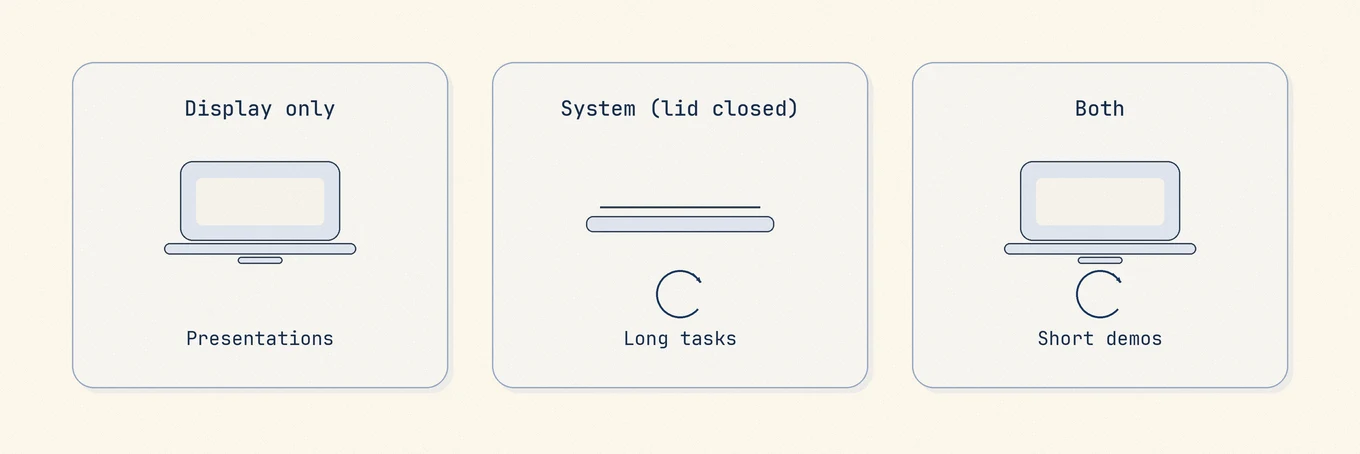
Keeping a Mac awake can mean several different policies:
| Policy | Keeps display awake | Keeps system awake with lid closed | Typical use |
|---|---|---|---|
| Display only | Yes | No | Presentations, reading, monitoring a live view |
| System / closed-lid tasks | Not necessarily | Yes | Long downloads, SSH-ish local jobs, overnight encodes on a laptop on power |
| Both | Yes | Yes | Demo machines and short supervised sessions |
Apple's own Energy settings still matter underneath: low power mode, display brightness, and "Prevent automatic sleeping on power adapter when the display is off" in System Settings › Battery / Energy change the baseline before any third-party override.
Apple documents sleep and wake behavior in Change Energy Saver / Battery settings (wording varies by macOS version). Read your Mac's panel once before blaming a utility.
Prefer timed sessions over infinite ones
Infinite keep-awake is the mode people forget. Timed sessions fail closed:
- Pick the shortest duration that covers the job (1 hour, 4 hours, or until you stop).
- Start the job.
- Let the timer end, or stop it when the job ends.
- Confirm the display and sleep behavior return to normal.
If you need something longer, start another deliberate session. Do not leave an unbounded override running because it might be convenient tomorrow morning.
Battery-aware rules that prevent bad nights
A keep-awake tool should respect the battery, not fight it.
| Situation | Safer behavior |
|---|---|
| On battery, level still healthy | Short timed session only; dim the display if you do not need full brightness |
| On battery, around 20% | Pause the keep-awake session; let macOS protect the remaining charge |
| Plugged in after a low-battery pause | Resume only if you still want the override |
| Unlimited session | Accept that it must survive a restart only if you still intend it; otherwise prefer timed modes |
| Closed-lid work on battery | Prefer power adapter; closed-lid plus keep-awake plus battery is how laptops go empty in a bag |
Also separate "screen on" from "prevent idle sleep." A presentation needs pixels. A multi-hour download often needs the system awake with the lid closed and the display off. Using the display-on policy for a download wastes energy for no benefit.
Pair keep-awake with the real bottleneck
Before you force the Mac awake, check whether sleep is even the problem:
- Is the job waiting on network authentication that drops when the Mac sleeps? Keep-awake helps.
- Is the job single-core bound and merely slow? Keep-awake will not shorten it.
- Is thermal throttling the limiter? More awake time at high temp may not finish sooner; fix airflow or reduce concurrency.
- Is the display the only thing sleeping while the process continues? Then you may not need a tool at all.
Activity Monitor › Energy and a simple timestamped log from your job give better evidence than guessing.
Everyday habits that help more than caffeine mode
- Plug in for long unattended work.
- Lower brightness when the display must stay on.
- Disable only the sleep behaviors you need for the session; leave Power Nap and other defaults alone unless you know why.
- Stop the session when you leave the desk.
- For demos, use a timed mode so a forgotten Mac does not run until the battery dies.
Where Mole fits
Mole's Keep Screen On lives in the menu bar with durations you pick (including until you stop), modes that cover display, closed-lid tasks, or both, and battery-aware behavior: sessions pause around 20% battery and can resume once power is connected. An unlimited session can survive a restart when you still want that policy. Timed sessions restore the previous mode and remaining time correctly after interruptions.
That design matches the rule above: overrides should be visible, timed when possible, and polite to the battery. Mole also keeps everyday controls nearby in the same menu bar surface, so you are not hunting a separate utility while a job runs.
If you also care about heat and process load during long sessions, keep Status and menu bar readings open beside this one.
FAQ
Is caffeinate enough?
Terminal caffeinate is fine for deliberate, short, scriptable jobs when you know which flags you passed. A menu bar control is easier to see and cancel. Both can drain a battery if you forget them.
Will Keep Screen On stop the battery from wearing out?
No. It trades sleep for availability. On battery, prefer short sessions and pause near 20%. Battery Care features (where available) are a separate topic from display sleep.
Can I keep a Mac awake in a bag?
You can, and you should not. Closed-lid work belongs on a hard surface with airflow, preferably on power. A keep-awake session in a bag is a heat and shutdown risk.
Does Mole need a license for Keep Screen On?
Mole's paid tools and trial rules are listed in the in-app docs and on the site. Scanning and several menu bar monitors stay usable without turning Keep Screen On into the only reason to install Mole; use the trial to see whether the timed sessions match your workflow.