Mac Menu Bar Status: Temperature, Fans, and Disk Space
A menu bar meter is only useful when you know what question it answers. Temperature without workload context creates panic. Free disk without understanding purgeable space creates false emergencies. A CPU percentage without the process that owns it creates busywork.
Status views and menu bar monitors earn their keep when they sit beside each other: heat, fans, memory pressure, disk headroom, and the processes responsible. One number in isolation is a headline. The set is a diagnosis.
For fan behavior under load, see Apple Silicon thermal throttling and Mac fans. For memory-specific reading, see Do you need a Mac memory cleaner?.
What each reading is for
| Signal | Useful question | Weak question |
|---|---|---|
| CPU % | Which process is active right now? | Is my Mac "at 40%" in the abstract? |
| GPU % | Is a browser, preview, or ML task driving the discrete/integrated GPU? | Should I reinstall macOS because GPU spiked once? |
| Temperature | Is this chip hot for this workload and ambient? | Is any number above 50°C a failure? |
| Fan RPM | Are fans responding, stuck, or being overridden? | Can I force max fans forever for "health"? |
| Memory pressure | Is macOS struggling to satisfy allocations? | Why isn't free RAM maximized? |
| Free disk | Do I still have working headroom for swaps, updates, and exports? | Why doesn't this match Finder's categories exactly? |
| Network speed | Is the physical interface busy? | Why is a VPN tunnel's virtual counter different? |
Apple Silicon Macs add one more nuance: performance and efficiency cores have different jobs. A busy efficiency core during background indexing is not the same story as a sustained performance-core render.
Temperature: trend and workload beat the absolute number
Chips are designed to run warm under load. What matters:
- Correlation with a task. Export, compile, local model, or game on: temperatures rise. Task off: they fall. That is normal.
- Sustained throttling symptoms. Frame time stretches, compile times balloon, fans stay loud after the work should have finished.
- Sensor identity. CPU proximity, GPU, and SSD readings are different instruments. Comparing a blog's "safe CPU temp" to a random sensor in a third-party app is how myths start.
If temperatures look alarming while the Mac is idle and has been idle for minutes, note ambient heat, whether the chassis is on a soft surface, and whether a process is still running hot in Activity Monitor. Do not reset SMC-style folklore as step one on Apple Silicon; start with process identity.
Fans: auto is a feature, not a compromise
On supported machines, fan curves exist to keep acoustics and thermals in a useful range. Forcing maximum fans can make a laptop unpleasant without fixing a runaway process. Forcing quiet mode during a sustained export can trade silence for throttling.
A practical approach:
- Leave automatic control on for daily work.
- Use a temporary cooler preset when you knowingly start a long render and care more about completion time than noise.
- Return to auto afterward so macOS can reclaim control.
- Investigate the process if fans stay loud with no obvious workload.
Disk space: free, purgeable, and "System Data"
Free space is not one concept:
- Truly free blocks ready for new writes.
- Purgeable space macOS can reclaim (local snapshots, disposable caches) when pressure rises.
- Category summaries in System Settings that group leftovers Apple does not itemize as apps.
Finder, System Settings, and df can disagree without anyone lying. Snapshots, clone files, and delayed reclaim all move the numbers. Before you buy a huge cleaner because System Data looks large, measure the large owners you can name:
df -h /
du -sh ~/Library/Caches/* 2>/dev/null | sort -h | tail -15
Then clear rebuildable caches with attribution. Do not delete unknowns under /System.
Processes: sort, identify, then act
A status panel should make the next action obvious:
- Sort by CPU or energy.
- Identify whether the row is an app, a helper, a browser renderer, or a system service.
- Quit or sample the owner; do not kill random
kernel_taskfolklore. - If a system process pins a core after long uptime, a restart can be a controlled experiment after you save work.
Browser helpers deserve aggregation. One Chrome window can look like twelve unrelated processes until you group them.
Background cost of the monitor itself
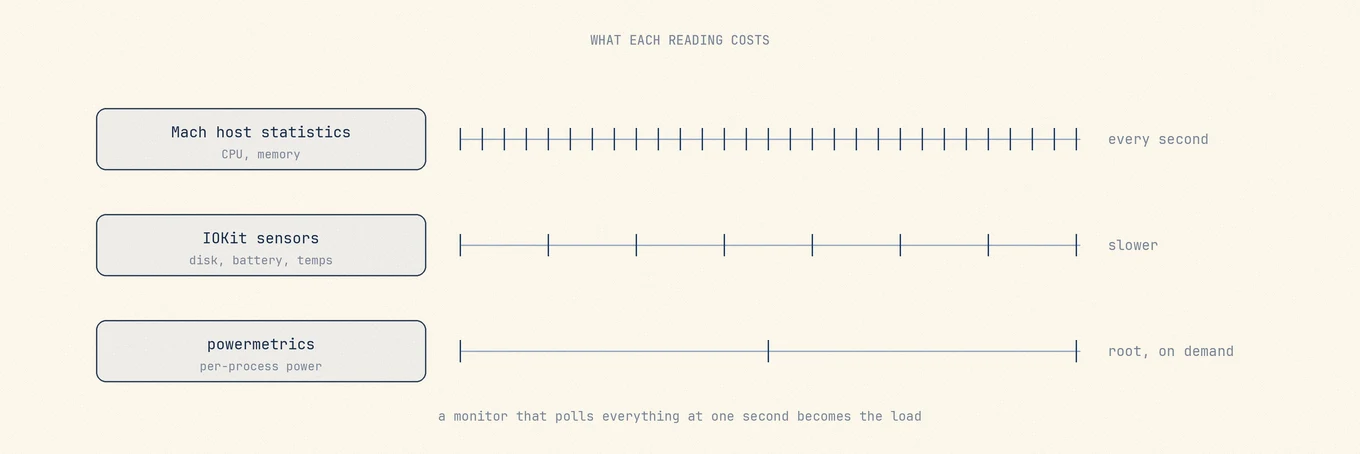
Always-on menu bar tools use some CPU, wakeups, and sometimes GPU for icon animation. Good monitors reduce refresh when another app is frontmost, release window memory shortly after you hide them, and avoid hammering disks for free-space probes. If a monitor is in your top energy consumers while idle, simplify the metrics or switch to a static icon until you need detail.
Bluetooth accessory battery alerts are in the same family: useful when they appear as notifications without forcing the full panel open; noisy when they poll so hard they become the story.
Where Mole fits
Mole's Status view and menu bar are meant to keep these signals honest in one place. Apple Silicon temperatures are steadier; menu-bar temperature and fan speed can refresh every second; free disk space is kept accurate in both Status and the menu bar. Processes can be sorted; the health score explains what it deducted; a low Bluetooth battery can alert you without opening the panel. Hidden windows release graphics memory within about a minute, and Status refreshes less while another app is in front so background use stays light.
Use Mole when you want live context next to cleanup and updates. Use Activity Monitor when you need Apple's canonical memory and energy breakdowns. Use both when a single number feels wrong; disagreement is a clue, not a reason to panic-install another meter.
FAQ
Is a hot MacBook during export damaged?
Not by heat alone within design limits. Watch for unexpected idle heat, repeated thermal shutdowns, or throttling that persists after the workload ends.
Why doesn't free disk match System Settings?
Categories, purgeable space, snapshots, and timing differ. Compare with df and named folder measurements before deleting anything you cannot attribute.
Should I run fans at maximum all day?
No. Use automatic control daily; reserve aggressive presets for known heavy jobs, then return to auto.
Does a menu bar monitor drain battery?
Any always-on sampler has a cost. Prefer tools that idle down in the background and let you choose a static icon when you do not need animation.