Discord, Slack, and Teams on Mac: Cache vs History vs Downloads
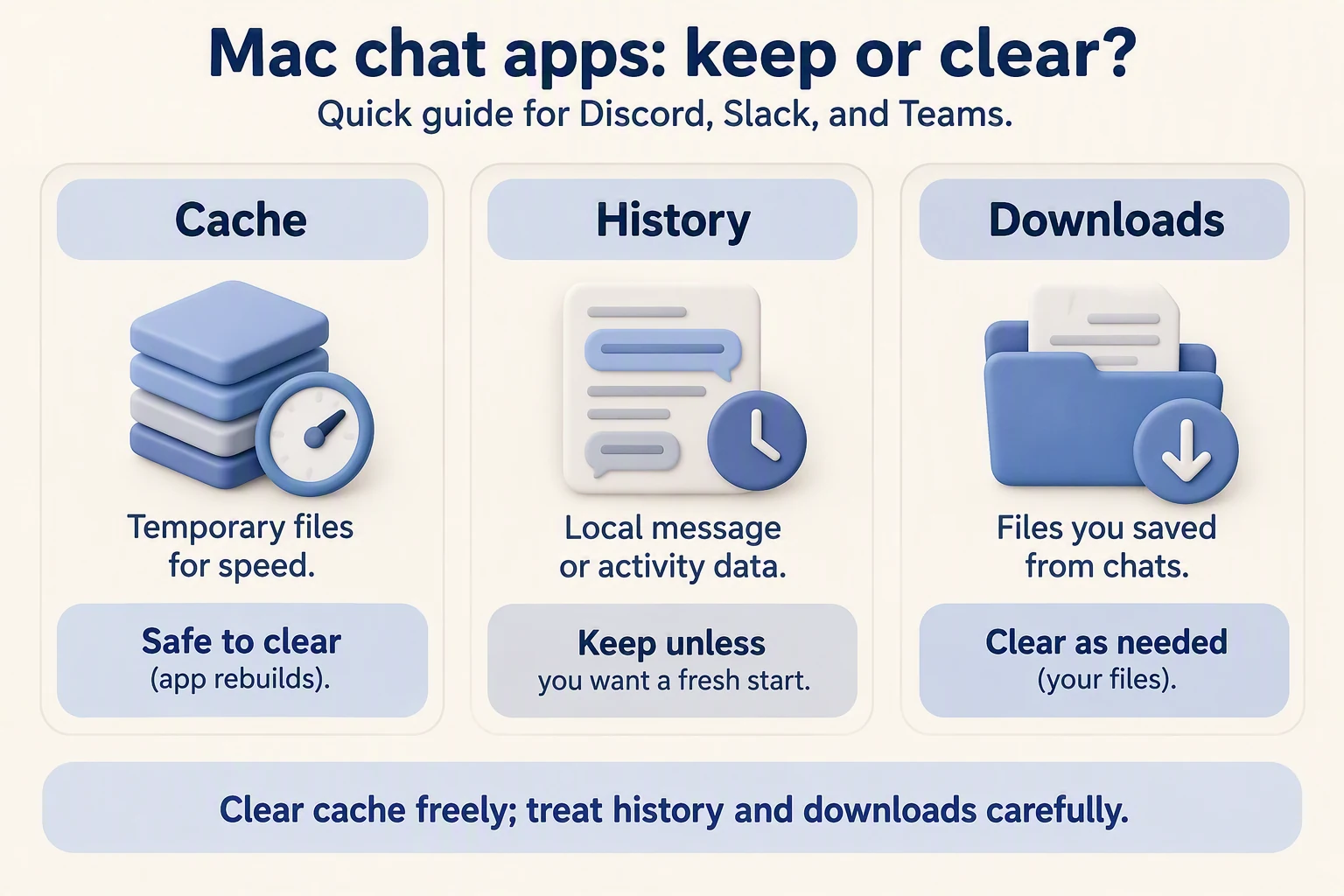
Discord, Slack, and Teams all get large on a Mac for the same reason, and the fix is the same decision each time: separate cache from history from downloads before deleting anything. Cache is regenerable and safe to clear; message history and saved files are not cache, and clearing them by mistake is the failure this guide is written to prevent.
This is a decision guide, not a "clear all caches" tip list. It uses "Mole" only
for Mole for Mac at mole.fit and its own mo command line tool, and it does not
quote per-app gigabyte figures, because they vary too much to be useful. Apple's
own Messages is a different app; to clear its attachments see clear Messages
storage on Mac.
The same three buckets for every chat app
Every desktop chat app splits its disk use the same way. Sort what you see into these buckets first, and the per-app steps below become obvious.
| Bucket | Typical contents | The decision |
|---|---|---|
| Cache | Media previews, avatars, temporary render files | Reclaimable; the app rebuilds it |
| History and databases | Local message store, workspace or server state | Keep by default; may be the only local copy |
| Downloads and attachments | Files you saved or received | Review one by one; some have no other copy |
| App bundle | The app in Applications | Only removed when you uninstall the app |
The order matters: decide the bucket first, then act. A large number is not a reason to delete; a confirmed cache is.
Discord on Mac
Discord keeps a cache of media previews and avatars that grows with use. Prefer Discord's own settings for clearing it where the current Mac client offers that, rather than deleting folders by hand. Confirm the option in the app's current version, since these menus change.
History in Discord largely lives on its servers, so signing in reloads your conversations; the local footprint is mostly cache and any files you downloaded. Review the downloads location before removing anything, and quit Discord before you inspect any Library folder so you are not touching files it holds open.
Slack on Mac
Slack separates a workspace cache from local state, and large media in busy workspaces is usually the cache. Prefer Slack's own clear-cache or troubleshooting step, documented in Slack Help, rather than guessing at folder paths, which differ between the App Store and direct-download builds.
Slack's Clear Cache and Restart restarts the app and reloads local cache; it does not delete messages held by your workspace. Clearing app data is a different step and can sign you out. Review files you saved or exported separately.
Microsoft Teams on Mac
Teams on Mac has shipped under more than one packaging, so the exact folder names depend on which build you have; check current Microsoft guidance rather than an old path. Prefer Microsoft's documented clear-cache or storage steps for your version.
Separate the cache from meeting downloads and any local recordings, which are files you may not be able to fetch again. Quit Teams completely before reviewing any folder, and let the app rebuild its cache on next launch rather than deleting state it needs to sign in.
A side-by-side decision checklist
- Measure first: find the app's folders in Storage settings or a disk view and see which is actually large.
- Classify each into cache, history, or downloads using the table above.
- Use the app's own clear-cache step before touching any Library folder.
- Quit the app completely, then review its
~/Library/Cachesand~/Library/Application Supportentries with care. - Never bulk-delete a shared vendor folder because one app looks large; confirm ownership first.
For the general rules behind "is this regenerable?", see which Mac caches are safe to delete, and for reviewing Library residue after an uninstall, review leftovers before you delete.
Where Mole fits
Mole's Clean and Analyze surface communication-app candidates with their paths and sizes for review; scanning is free without a license, and you decide what to remove. It does not claim to auto-safely wipe chat data, and it leaves history-shaped items for you to judge rather than preselecting them. For exactly what it removes and what it refuses to touch, see is Mole safe.
Further reading
- Which Mac caches are safe to delete: the regenerable-versus-not rule for any app.
- Clear Messages storage on Mac: the same job for Apple's Messages, a different app.
- Review leftovers before you delete: how to judge Library residue by ownership.
FAQ
Will clearing cache log me out or lose history?
Clearing cache may make an app reload or ask you to sign in again, but it does not erase messages held by the service. Slack's Clear Cache and Restart is distinct from clearing app data, which signs you out. Files you downloaded are separate; review those before deleting.
Can I delete the whole Slack or Discord folder?
Deleting a whole app folder is an uninstall-level action, not a cache cleanup. It removes local state and any local-only files together, so treat it as removal, not reclaiming. Clear the cache through the app first, and only remove the folder if you actually mean to uninstall.
Do Electron apps share the same pattern?
Largely yes. Many desktop chat apps are Electron-based and keep a rebuildable media cache plus local state under Application Support, so the cache-versus-history decision transfers. The exact folder names still differ per app and per build, so confirm before deleting.