# CleanMyMac Alternatives: Choose the Tool for the Job
> Compare built-in macOS tools, AppCleaner, DaisyDisk, iStat Menus, OnyX, Sensei, CleanMyMac, and Mole by job, safety, and long-term cost.
Published: 2026-06-24 | Updated: 2026-08-25
Searching for a CleanMyMac alternative sounds like a product question, but it is
really a job-definition question. Cleaning caches, uninstalling apps, mapping disk
usage, monitoring hardware, and scanning for malware are different jobs with different
risk. No utility becomes safer or better merely by placing all of them behind one
button.
This guide compares the main choices by the work they are designed to do, what they do
not replace, and how their licensing affects long-term cost. Features and prices change,
so verify the linked vendor pages before buying.
## Start with the job you actually need
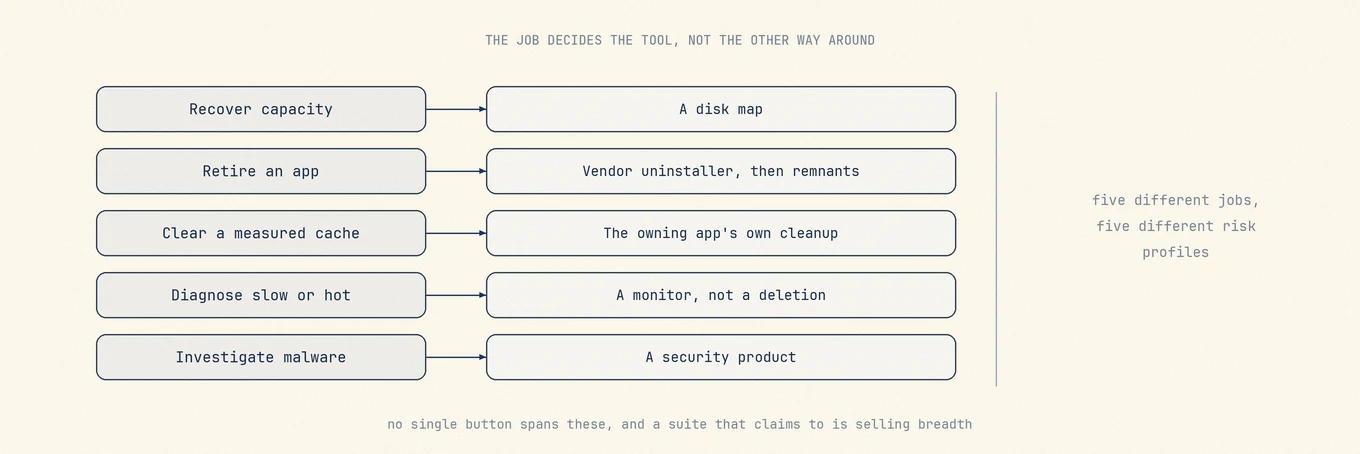
Choose one primary outcome:
- **Recover disk capacity:** begin with a disk map. It tells you whether the weight is
Photos, Docker, Xcode, device backups, downloads, or a true cache.
- **Retire an app:** use the vendor uninstaller for software with drivers, extensions,
VPN components, or privileged helpers. Use a remnant scanner for simple app support
files after that.
- **Clear a measured cache:** prefer the browser, package manager, or app's own cleanup
command because it understands its indexes and shared data.
- **Diagnose a slow or hot Mac:** use Activity Monitor and a system monitor. Deleting
files cannot fix a CPU loop or explain thermal throttling.
- **Investigate malware:** use a security product with current detection and response
capability. A cache cleaner is not a substitute.
If the Mac has comfortable available capacity and no diagnosed problem, the best
cleanup may be no cleanup. macOS already manages memory cache, purgeable data, and
local snapshots under pressure.
These are five jobs with five risk profiles, which is why no single button spans them and why a suite is selling breadth rather than safety.
## Evaluate safety before feature count
For a focused answer to the brand question, use the same criteria in [Is CleanMyMac Safe?](https://mole.fit/blog/is-cleanmymac-safe) before comparing feature lists.
A preview is necessary but not sufficient. A convincing utility should answer these
questions clearly:
1. Does it show the exact path, owner, size, and consequence before removal?
2. Does it distinguish cache from preferences, profiles, messages, databases, and
shared containers?
3. Does it use the owning app's cleanup interface when one exists?
4. Are ordinary removals recoverable, and are skipped or failed items reported?
5. Which features require Full Disk Access, Automation, or a privileged helper?
6. How quickly are rules updated when macOS and third-party apps change?
7. Does the license include future major versions, and how many Macs does it cover?
A large "junk found" number is not evidence of quality. Re-download cost, lost offline
access, and shared app data matter as much as bytes.
## The choices by job
### Built-in macOS tools for occasional maintenance
System Settings, Activity Monitor, Finder, App Store, Time Machine, and Terminal cover
most one-off tasks. They cost nothing, expose the original system state, and avoid
installing another always-available utility. Their weakness is assembly: storage,
startup, updates, processes, and privacy live in separate interfaces, and hidden
Library paths are hard to attribute.
This is the right starting point for a Mac that needs attention only a few times a
year. It also provides the baseline against which every paid tool should save time.
### Mole for a review-first multi-tool
Mole combines cleanup, software management, disk analysis, and system status, while keeping discovery and confirmed removal as separate steps.
[Mole](https://mole.fit/mac-cleaner) combines reviewed cache categories, app and update inventory, uninstall
remnant discovery, a disk treemap, and system status in one native app. Ordinary file
removals go through a review plan and Trash, and personal stores such as Photos,
Messages, and local model libraries remain with their owning apps.
Its current license is a one-time purchase with lifetime updates for two Macs, and it
requires macOS 14 or later. It does not replace a malware-response product, a backup,
or a vendor uninstaller for system-integrated software. Choose it when the combined
inventory saves recurring work and its supported OS range fits your Macs.
### CleanMyMac for a guided mainstream suite
CleanMyMac combines cleanup, uninstall, performance, privacy, and security-oriented
features in a guided interface. It is the familiar choice for someone who wants a
broad consumer suite and prefers vendor support over assembling built-in tools.
MacPaw currently offers both subscriptions and one-time purchases. Its
[purchase documentation](https://macpaw.com/support/cleanmymac/knowledgebase/purchase-options)
explains an important distinction: a subscription includes future major upgrades
while active, while a one-time purchase covers the current major version. Compare that
upgrade policy and device count with the checkout price. MacPaw also documents feature
differences between its own store, the App Store, and Setapp editions, so compare the
edition as well as the product name. As with any broad suite, review cleanup candidates
and understand which modules request additional permissions.
### Mole vs CleanMyMac: what actually changes
Mole can replace the CleanMyMac jobs that involve cache cleanup, app inventory and
remnants, disk mapping, and live system status. It does not replace malware scanning,
real-time threat monitoring, or a backup. CleanMyMac is the better fit when those
security modules and a guided vendor-supported suite are part of the purchase. Mole is
the better fit when you want a native app that keeps discovery and removal separate and
uses a one-time license.
| Question | Mole for Mac | CleanMyMac |
| --- | --- | --- |
| Native app or CLI? | A native Mac app; the free Mole CLI is a separate product surface | A native Mac app |
| Cleanup review | Shows candidate path, owner, size, and category before confirmation | [Smart Care](https://macpaw.com/support/cleanmymac/knowledgebase/smart-care) preselects tasks; individual modules expose details for review |
| Ordinary removal | Uses a review plan, Trash, and an operation log | Recovery behavior differs by module, so check the selected task before running it |
| App management | App and update inventory, startup items, uninstall remnants; vendor uninstallers still come first for system-integrated software | App updates, uninstall, and leftover removal in the suite |
| Disk analysis | Interactive treemap of files and folders | Disk breakdown, Space Lens, and large-file tools |
| System status | CPU, memory, GPU, disk, network, battery, fans, and processes, including a menu bar HUD | CPU, memory, disk, network, battery, and health indicators in the [CleanMyMac Menu](https://macpaw.com/support/cleanmymac/knowledgebase/cleanmymac-menu) |
| Malware response | None; use a maintained security product | [Malware scanning](https://macpaw.com/support/cleanmymac/knowledgebase/malware-removal) plus optional real-time and background monitoring |
| License | $19 once, two Macs, lifetime updates | [Subscription](https://macpaw.com/support/cleanmymac/knowledgebase/purchase-options) includes future major versions; one-time purchase covers the current major version |
If the Mole column matches the work you need, [try Mole for Mac](https://mole.fit/mac-cleaner). Each paid tool can
be used twice before purchase, so the comparison can start with the actual scan rather
than a feature list.
### App Cleaner & Uninstaller for app lifecycle work
Nektony's [App Cleaner & Uninstaller](https://nektony.com/mac-app-cleaner) is no longer
only a small remnant remover. Its current feature set also covers startup programs,
extensions, and app updates. Uninstall remains the central job, which makes it a useful
fit for people who frequently test and retire apps but do not need a full system
dashboard.
The same uninstall boundary still applies: vendor workflows come first for VPN,
antivirus, virtualization, audio, and driver software, and group containers require
shared-ownership review. Check its current subscription and lifetime options on the
[official purchase page](https://nektony.com/mac-app-cleaner/buy).
### DaisyDisk for understanding disk usage
[DaisyDisk](https://daisydiskapp.com/) is a focused visual disk analyzer. It is a good
choice when the real question is "what is large?" rather than "which caches should a
suite remove?" A map is especially useful for virtual disks, media libraries, archives,
and developer trees that do not belong in a generic junk category.
DaisyDisk uses a one-time license according to its
[pricing documentation](https://daisydiskapp.com/support/pricing/). It does not replace
an app-aware uninstaller or a continuous system monitor. After finding a large item,
use Finder or the owning app to decide whether it is disposable.
### OnyX for explicit maintenance controls
[OnyX](https://titanium-software.fr/en/index.html) is free and exposes maintenance and
configuration controls directly. Separate releases target specific macOS versions,
which is a useful warning: low-level maintenance behavior is tied to the OS, and the
matching build matters.
Choose OnyX when you understand the operation you intend to run and want an explicit
control rather than an all-in-one recommendation. It is not the ideal first tool for
someone who wants the app to decide what is safe without review.
### iStat Menus for long-running system history
[iStat Menus](https://bjango.com/mac/istatmenus/) focuses on menu-bar monitoring and
historical system data. It is the better fit when the question involves a CPU spike,
network burst, fan trend, or battery behavior that must be correlated over time. Its
history and customization are deeper than a general cleanup suite needs to be.
It does not clean caches or uninstall apps. That focus is an advantage when monitoring
is the job: the product can be judged by sampling cost, sensor coverage, history,
privacy, and clarity rather than by deletion breadth.
### Sensei for a dashboard-led suite
[Sensei](https://cindori.com/sensei) combines hardware and performance information with
cleanup and app-management features. Consider it when SSD, battery, and thermal context
are the main attraction and cleanup is secondary. Verify current model support,
licensing, and the exact cleanup preview on the official site before deciding.
## Quick comparison
| Choice | Primary strength | Important boundary | License approach |
| --- | --- | --- | --- |
| Built-in tools | Original system controls | Manual and scattered | Included with macOS |
| Mole | Integrated review and disk map | Not malware response or backup | One-time, lifetime updates |
| CleanMyMac | Guided broad suite | Review permissions and upgrade policy | Subscription or current-major purchase |
| App Cleaner & Uninstaller | App lifecycle and remnants | Vendor uninstallers still come first | Subscription or lifetime option |
| DaisyDisk | Visual disk attribution | Not app-aware cleanup or monitoring | One-time |
| OnyX | Explicit maintenance controls | Requires macOS and operation knowledge | Free |
| iStat Menus | Monitoring history and customization | No cleanup or uninstall | One-time with major upgrades |
| Sensei | Hardware-led dashboard | Verify current support and cleanup scope | Vendor options vary |
## Make the decision without marketing
Try the narrowest tool that answers the diagnosed problem. Run a scan without deleting,
inspect whether the candidates are understandable, and compare the result with built-in
tools. Check the official download source, macOS support range, permissions, recovery
behavior, and upgrade policy.
Choose a suite when its integrated inventory repeatedly saves time. Choose a focused
tool when one job matters more than breadth. Choose no utility when macOS already gives
you the answer. The best alternative is the one whose scope and trust boundary match
the work, not the one that promises the largest cleanup number.
## FAQ
### Is CleanMyMac safe to use?
It is notarized by Apple, which means it has been checked for malicious code, and treating
it as malware is wrong. Notarization is not a correctness check though: it says nothing
about whether a tool's deletion rules match your machine. Judge any cleaner, this one
included, by whether it shows the candidate list before deleting, refuses when a file
changed after the scan, and leaves a log you can read afterwards.
### Is CleanMyMac worth paying for?
It depends on whether you need a suite or one job. If you repeatedly use several of its
modules and value the integrated inventory, the subscription buys real time back. If you
only ever open it to uninstall an app or free some space, a focused tool or a built-in
macOS feature covers that without a recurring bill. Price the tool against the job you
actually diagnosed, not the one the marketing page describes.
### Can Mole replace CleanMyMac?
It can replace cleanup, app management, disk analysis, and system monitoring for people
who prefer to review the work before removal. It cannot replace CleanMyMac's malware
scanning or real-time protection, and neither product replaces a tested backup or the
vendor uninstaller for system-integrated software.
### Is there a free alternative that does the same jobs?
For individual jobs, yes. AppCleaner covers uninstalling, OnyX covers maintenance tasks,
and macOS Storage Settings covers basic cleanup. For the combined workflow the honest
answer is that free tools split it across several apps, and whether that trade is worth
it depends on how often you do the work.
### Does open source make a cleaner safer?
It makes the deletion rules auditable and lets bad ones be reported and fixed in public,
which is meaningful evidence. It is not a guarantee, because auditable is not the same as
audited. Treat it as one input next to previews, refusal behavior, and logs.
### What should I check before running any of these?
Run a scan without deleting and read the candidate list. If the entries are understandable
and the tool can tell you why each one is there, that is a good sign. If the first
meaningful output is a number of gigabytes and a Clean button, you are being asked to
trust a decision you were never shown.
---
Canonical HTML page: https://mole.fit/blog/cleanmymac-alternative
Blog index for agents: https://mole.fit/blog/llms.txt
Site index for agents: https://mole.fit/llms.txt